
How to Specify Tiles for Commercial Projects in the USA (Complete Guide)
Tile failures don’t usually happen during installation—they begin at the specification stage.
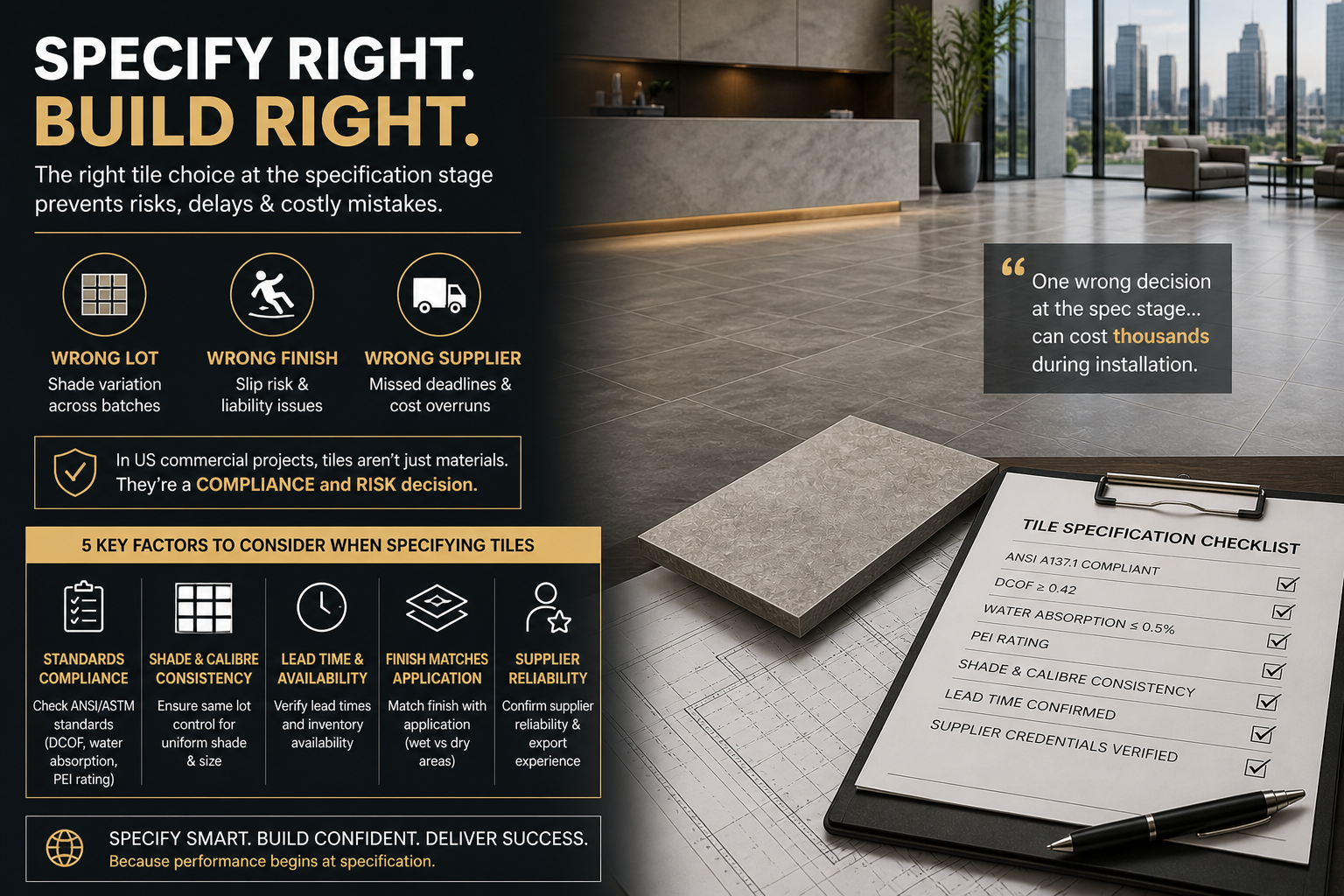
In US commercial projects, tile selection is not just about design. It’s about performance, compliance, and risk management.
A wrong choice can lead to slip hazards, costly replacements, and project delays.
This guide breaks down how to specify tiles correctly to avoid those issues.
Why Tile Specification Matters in Commercial Projects
In the US, commercial spaces must meet strict safety and performance standards.
Improper tile specification can result in:
Visible shade variation across batches
Slip-and-fall liability risks
Maintenance and durability issues
Delays due to supply or inventory gaps
For architects, contractors, and importers, this makes tile selection a technical decision—not just a visual one.
Key Standards for Tile Specification in the USA
To ensure compliance, tiles must meet recognized standards:
ANSI A137.1 (Tile Quality Standard)
Defines:
Water absorption (porcelain ≤ 0.5%)
Strength and durability
Dimensional consistency
ASTM Standards (Performance Testing)
Common tests include:
ASTM C373 – Water absorption
ASTM C648 – Breaking strength
ASTM C1026 – Freeze-thaw resistance
ANSI A326.3 (DCOF) – Slip resistance
These standards ensure tiles perform well in real-world commercial environments.
5 Key Factors to Consider When Specifying Tiles
Slip Resistance (DCOF Requirements)
For wet or high-traffic areas, tiles must meet DCOF ≥ 0.42.
This is critical for:
Restaurants
Lobbies
Bathrooms
Ignoring this can lead to serious liability issues.
2. Shade & Calibre Consistency
Tiles from different batches can vary in:
Color (shade variation)
Size (calibre difference)
Always ensure same lot supply to maintain uniform appearance.
3. Water Absorption & Tile Type
Porcelain tiles (≤ 0.5% absorption) are ideal for:
High-traffic areas
Outdoor applications
They offer better durability and moisture resistance.
4. Finish Selection (Based on Application)
Choose finish based on usage:
Matte / textured → Wet or commercial areas
Glossy → Low-traffic or wall applications
Wrong finish = higher maintenance + safety risks.
5. Supplier Reliability & Lead Time
Even the right tile can fail a project if:
Delivery is delayed
Inventory is inconsistent
Export handling is poor
Work with suppliers who have:
Export experience
Stable production
Proven track record